MENU

Heat Shrink Tubing Manufacturing Process: Quality Control from Extrusion to Final Product
Heat shrink tubing is extensively used in areas of electronics, power distribution, automotive, telecommunications, and industrial applications, offering functions such as electrical insulation, waterproofing, dust protection, and abrasion resistance. However, behind every high-quality heat shrink tube lies a series of precision manufacturing processes and stringent quality control measures to ensure consistent performance and reliability.
Every step in the manufacturing process from raw material compounding, extrusion, irradiation cross-linking, and tube expansion—plays a critical role in determining the shrink ratio, thermal resistance, and service life of heat shrink tubing. In this article, we will walk you through the complete manufacturing process and demonstrate how stringent process control ensures superior product quality, consistent performance, and manufacturing reliability.
Introduction to the Heat Shrink Tubing Manufacturing Process
The manufacturing process of heat shrink tubing typically includes the following steps:
Raw Material Compounding ➜ Extrusion ➜ Irradiation Cross-linking ➜ Tube Expansion ➜ Final Inspection & Packaging
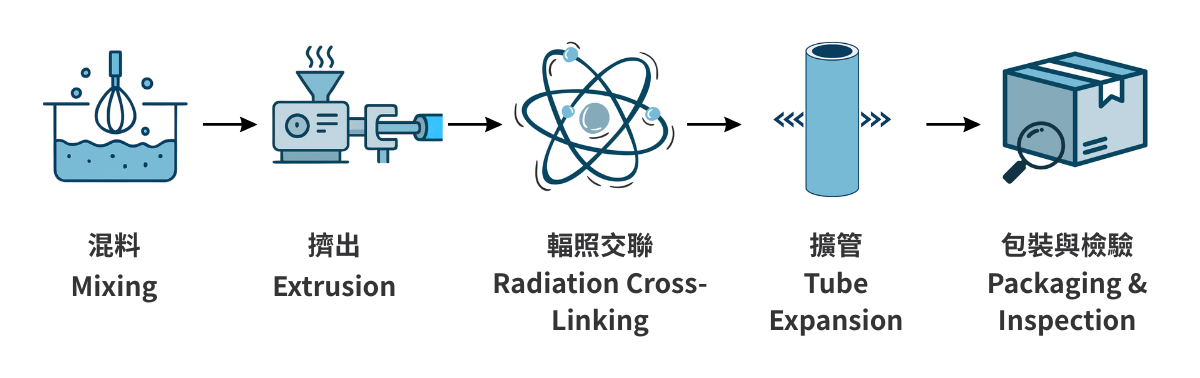
Every stage of the manufacturing process is closely linked to the quality of heat shrink tubing. In particular, stringent process control is essential to ensure dimensional stability, shrink ratio, and optimal material properties.
Raw Material Compounding: Establishing the Performance Characteristics of Heat Shrink Tubing
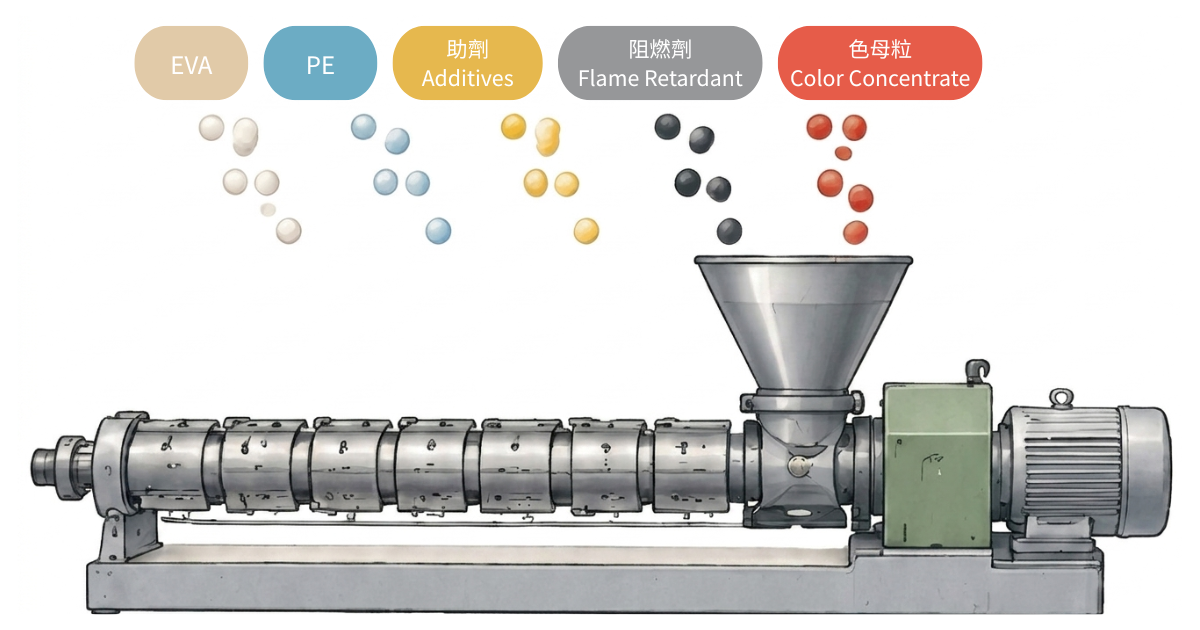
Raw material compounding is the initial stage of the heat-shrink tubing manufacturing process. Uniformly blend the EVA, PE, processing additives, flame retardants, and color masterbatch in accordance with a specified formulation.
This formulation will directly influence the tubing's flexibility, thermal resistance, flame-retardant properties, and shrinkage performance. To ensure consistent product quality, manufacturers rely on advanced compounding technology and strict formulation control to achieve uniform material properties from batch to batch.
Extrusion: Forming the Initial Dimensions of Heat Shrink Tubing
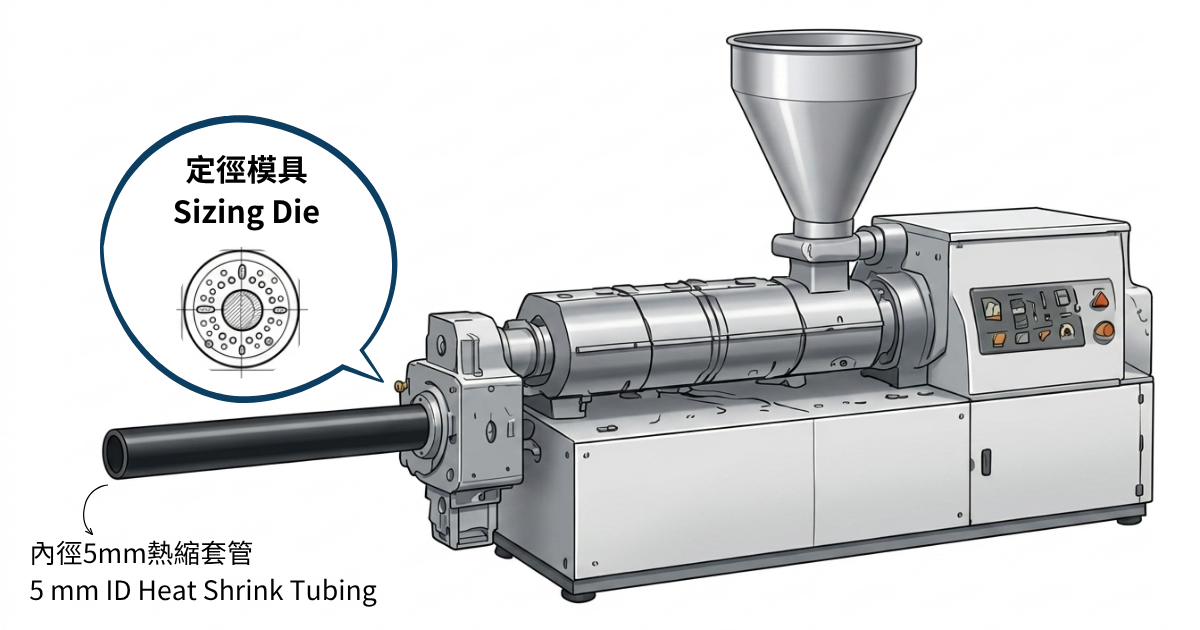
Following raw material compounding, the material is processed through an extruder, where it is melted, plasticized, and extruded through a sizing die to form the tubing.
For example, a 5 mm sizing die produces tubing with an inside diameter (I.D.) of 5 mm.
Special attention should be paid to dimensional stability, thickness uniformity, and surface quality during this stage to avoid unstable heat-shrinking effects later on.
A well-controlled extrusion process is fundamental to ensuring the overall quality and reliability of heat shrink tubing.
Irradiation Cross-linking: Enhancing Thermal Resistance and Shape Memory
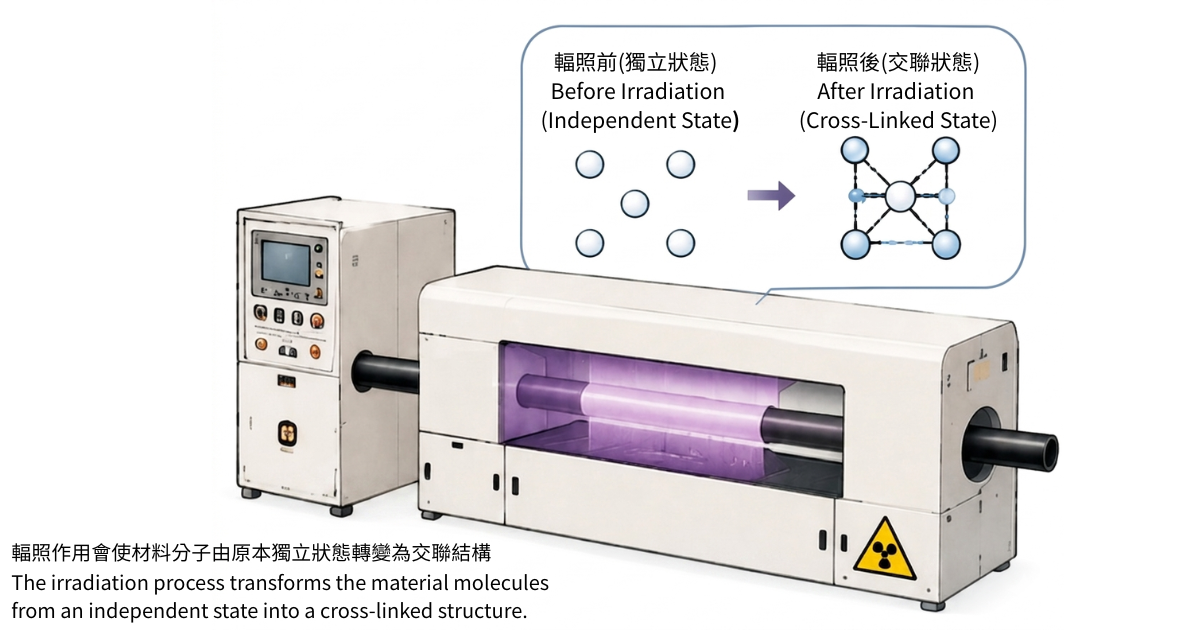
After the tubing has been extruded, it undergoes electron beam irradiation cross-linking using an electron accelerator.
Meanwhile, the polymer molecules are transformed from independent molecular chains into a three-dimensional cross-linked network. This significantly enhances the heat shrink tubing's:
- Electrical insulation properties
- High-temperature resistance
- Abrasion resistance
- Chemical resistance to acids and alkalis
Meanwhile, the material acquires shape memory, enabling it to retain the dimensions of its original extruded diameter. This shape-memory effect is the key to the tubing's heat-shrink functionality during subsequent heating.
Tube Expansion: Creating the Heat-Shrink Function and Shrink Ratio
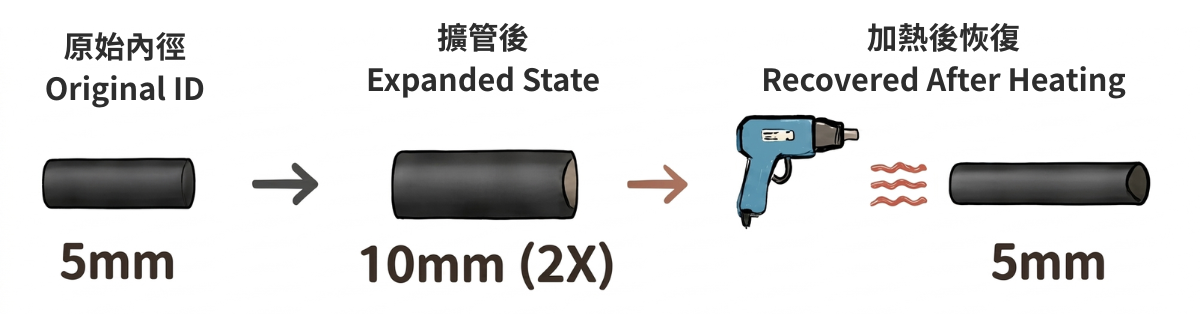
After irradiation, the plastic tubing is heated and expanded using an expander.
For example, a 2:1 heat shrink tubing can expand from a 5mm diameter to 10mm; a 3:1 tubing can expand to 15mm.
When heated by the user, the heat-shrink tubing returns to its original diameter, creating a tight seal.
This stage requires precise control of temperature, speed, and expansion ratio to ensure the shrinkage ratio and product stability.
How Does Quality Control Affect the Performance of Heat Shrink Tubing?
The quality of heat-shrink tubing depends not only on the raw materials but also on a comprehensive manufacturing process control system.
From raw material formulation, dimensional accuracy, and irradiation cross-linking to heat-shrink performance testing, every manufacturing stage must undergo stringent inspection and quality control to ensure consistent electrical insulation, waterproof sealing, thermal resistance, and mechanical protection.
This is especially critical in electronics, automotive, medical, and industrial equipment applications, where reliable heat shrink tubing is essential for ensuring product safety, long-term durability, and operational reliability.

Although heat-shrink tubing may seem to be a simple product, its manufacturing process combines advanced polymer engineering, precision manufacturing, and strict quality management. From extrusion and electron beam irradiation cross-linking to tube expansion, every process plays a vital role in determining the final product's performance.
Only through a well-controlled manufacturing process and comprehensive quality assurance can manufacturers produce heat shrink tubing with consistent shrink performance, long-term durability, and high safety standards, meeting the diverse requirements of wire and cable insulation, environmental sealing, and mechanical protection across a wide range of industries.